|
Representing |
||
|
audiodharma CABLE COOKER
Stereophile Recommended Component for 3 Years Running THE CABLE COOKER
3.5 GREATLY IMPROVES
the sound quality of all forms of interconnects (including A-V and phono), speaker cabling, AND power cabling beyond any normal break-in
cycle. RAPID, SUPERIOR BREAK-IN AND
CONDITIONING ... conditions more thoroughly because the cabling is exposed
to extreme signal levels and a special waveform that does not occur in
normal system operation.
SOPHISTICATED, HIGH-EFFICIENCY,
CONTINUOUS DUTY CIRCUIT supplies in excess of 1 watt for interconnects
and 22 watts for speaker and power cabling, in addition to a highly
dynamic extended-frequency sweep (from 0 DC to over 40KHz).
UNIVERSALITY OF USE ... allows break-in
and conditioning of interconnects, speaker cabling, and power cabling
simultaneously.
INTERNATIONAL COMPATIBILITY... universal
switching power supply may be used on any continent....usable with all
line voltages from 90VAC to 260VAC, and AC input frequencies from 47Hz
to 63Hz.
CUSTOM ADAPTORS available for daisy
chaining power cables and speaker cables.
DESIGNED & MANUFACTURED IN THE U.S.A ...
BUILT TO LAST
TWO-YEAR FULLY-TRANSFERABLE WARRANTY
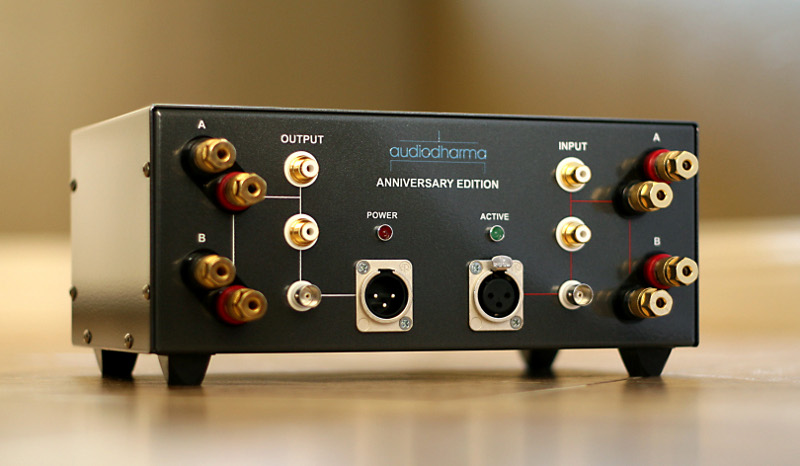
(parts & labor) What is the difference between the Standard Plus version, and Anniversary Edition? Firstly, the circuitry for the Standard Plus Cooker is identical with that of the Anniversary Edition, as is the chassis. Both versions offer full cryogenic treatment of all connectors, switches, internal wiring, and circuit board. The primary difference between the models is the binding post hardware. The Standard Plus Cooker features gold-plated, color-coded, hex-shaped plastic binding posts, and is perfect for use with banana terminations and lightweight speaker cables terminated with lighter-weight spades. Solid-core, bare wire
can also be conditioned (up to 10-gauge) via a conveniently-placed hole in the post itself. Please explain what the bridging switch does. With the original version 2.0, interconnects and speaker cable, OR interconnects and power cabling could be broken-in together....just not all three. This is due to the nature and necessity of wiring the connectors in series for the best possible signal integrity (from the Cooker). The
bridging switch circuit allows simultaneous break-in of all three types of cables without any signal degradation. It is especially useful and time-saving for those who have quite a bit of cabling to condition, and for those who are performing a periodic "recharge" of their cabling on a regular basis. What type of cables can be broken-in? The Cable Cooker can condition most types of audio/video cabling. The front panel includes RCA, BNC, and XLR connectors, plus 5-way speaker binding posts. These binding posts accept spades, bananas, and of course, bare wire. The Cooker does not have an S-video connector on it, but Radio Shack or other popular commercial suppliers have an RCA-to-S video adaptor that may be used to break in that type of cable. Microphone cables, guitar cables, and some headphone cables can be conditioned as well with the use of a ¼" plug-to-RCA adaptor. Can multiple pairs of interconnects be broken in simultaneously? Absolutely. RCA-terminated interconnects may be daisy-chained through the use of barrel connectors (a few pair are supplied with every Cable Cooker). XLR terminated interconnects simply snap together in series, oriented in the correct direction. How are power cables broken-in? Each Cable Cooker is supplied with a pair of reverse-male/female, 3-blade/IEC adaptors to enable one power cable to be broken in. These are professionally terminated with Deltron banana connectors that insert into two specific binding post sets on the front panel. Power cable break-in occurs on the same high-level circuit designed for speaker cable break-in. Additionally, we have "extension adaptors" made so that power cables may safely be daisy-chained as well. These extension adaptors are available for $10 each. Each adaptor allows an additional power cable to be conditioned (for instance, 3 extension adaptors allows 4 power cables to be broken-in). For a speaker cable requiring 200 hours of break-in, how long should it be plugged into the Cooker? The general guidelines for new speaker cabling are from between 3 days to 4 1/2 days. The Cooking time (for all types of cabling) is directly dependent upon the gauge of the conductors, and the amount of dielectric material. Incremental Cooking-and-listening tests are advised to determine the "best" Cooking time for a particular cable. Speaker cables that have been in a system for some time might only need 24 to 36 hours of conditioning. Again, this is recommended on a periodic basis, performing what we call a "recharge". Cooker owners are advised to do on a consistent basis to maintain optimal system performance. Conditioning is not a one-time phenomenon. Can interconnects, speaker cabling, and power cabling be broken-in together? Yes. In normal operation interconnects and speaker cable, OR interconnects and power cabling may be conditioned together... just not all three. The bridging switch allows the simultaneous conditioning of all three types of cables, which is a time saver when performing the recommended periodic recharges. How about phono cables? How do I break these in?
For vinyl lovers, we make a special DIN-to-RCA phono adaptor that allows both tonearm wire and/or phono cables to be broken-in. In our opinion, due to the incredibly low voltage produced by cartridges (especially low output MC's), tonearm wire and phono cables are "never" broken-in and fully conditioned. The Cable Cooker produces a multiplex signal that is approx. 2000 times stronger than what the average MC cartridge outputs. Dung Tri Mai uses this phono adaptor, and the Cable Cooker, for all new Triplanar production. What is the maximum "capacity" of the Cable Cooker? There is NO practical limit. You can Cook as many interconnects, speaker cables, and power cables as you wish. There is no degradation/loss of signal strength or integrity, no matter how many cables are placed on the Cooker. The only exceptions might be those designs with extraordinarily heavy-gauge conductors and complex geometries. Some cable manufacturers pre-condition 500-foot spools of cabling, and dozens of power cables simultaneously, which shows the ability of the Cable Cooker to condition longer lengths. How long does it take to break-in cables?
That is dependent upon the gauge of the conductors, the number of conductors, and the amount of dielectric material. Generally, for brand new cable, the suggested guidelines are 2 to 2 1/2 days for interconnects... 3 to 4 1/2 days for speaker cables... and 4 to 5 days for power cabling. Heavier-gauge designs, and those with more complex wiring geometries usually require more conditioning time than what the above guidelines show. Many customers have determined that "more is more" in these cases, performing additional conditioning in incremental stages. Periodic Cooking-and-listening tests are essential to determine the optimal conditioning time for each design. Does longer conditioning time mean better performance? Can I over-Cook my cables? Will they be damaged? Over-Cooking can reduce the performance, at least temporarily. The characteristics of this are a reduced or diminished soundstage and a dull, lifeless quality to the music. If this situation occurs, merely letting the cables physically rest, and settle, then putting them back in the music system to play for a few hours brings them back to their optimal performance level. Over-Cooking does NOT do any damage to the cabling whatsoever. Again, incremental Cooking-and-listening tests are highly recommended to avoid over-Cooking one's cables. Will plugging (only) a pair of speaker cables versus speaker cables and interconnects result in different break in time for the speaker cables? Not at all. Interconnects (RCA, BNC, and XLR's) are conditioned on a separate, lower-power circuit from the higher-power speaker cable circuit. Therefore, they are independently conditioned and break in times are not related, nor diminished due to conditioning them simultaneously. The signal generated by the Cooker is quite powerful, and multiple pairs of cables may be daisy-chained as well. Will cables revert back over time requiring a second burn in, or are the results permanent? Unless cabling is completely disconnected for a long period of time, we don't think they completely revert back to their original, raw state. However, in our experience, all cables retrograde in performance over time. Break-in or conditioning is a long-term, but not permanent phenomenon. Cabling performance improves (as does one's system) with a periodic "recharge" of 24 to 36 hours every few months, and many long-time Cooker owners continue to enjoy this benefit. This makes owning the Cable Cooker a great long-term value. Highly recommended! Can Cooking cables with network boxes (such as MIT & Transparent Audio) damage them in any way? Transparent cabling (all models, including Opus) is fine on the Cable Cooker, and MIT cabling performs without incident as well. Contrary to the language on MIT's website, there have been NO problems with any of their cables when conditioned on the Cable Cooker. If fact, I have a number of customer reports stating that numerous models of MIT cabling (including Oracle) performed splendidly, and their performance was suitably improved, as would be expected.
What else can the Cable Cooker break-in other than cables?
Some manufacturers are using the Cable Cooker to break-in transformers, capacitors, and bulk wire. A few customers have successfully conditioned Bybee filters and Bybee Wire, the Richard Gray Power Company Line Enhancer, and various parallel-design AC line conditioners including Acoustic Revive, Audience, Audio Magic, Shunyata, Sound Application, and Walker Audio. AC duplex receptacles are easily conditioned as well. Customers have also reported great success conditioning various aftermarket capacitors, including Audience, Dueland, Mundorf, and VH Audio. Since Teflon caps typically have the longest break-in periods, the Cable Cooker provides an exceptional benefit for those as well.
What adaptors are available with my Cable Cooker?
extra 15-amp IEC power cable adaptor....$16 I live outside the United States. Do you make a 220/240 volt version? The Cable Cooker circuitry was designed around a "universal" switching DC power supply, which will operate with any line voltage and frequency around the world. Simply use a generic power cord (from the wall), plug it into the DC power supply, and then plug the DC adaptor into the Cable Cooker. Please tell me the shipping weight and dimensions of the Pro version Cable Cooker versus the standard Cable Cooker. Shipping weight for the Pro Cooker is approximately 7 pounds. The Standard Plus Cooker's shipping weight is approximately 6.5 pounds. The dimensions are identical, as they use the same chassis. Each Cooker is 12 inches wide x 6 inches deep x 4.75 inches tall (approx. 33cm x 23cm x 18cm) For any further questions, please contact audio excellence az at 602-277-0799 or alan@audioexcellenceaz.com
We
accept
What custom adaptors are available with my Cable Cooker?
(all adaptors are cryogenically-treated at -320F. for improved conductivity and superior performance)
audiodharma CABLE COOKER UPGRADES
CONNECTIONS
COMMENTS
BRIDGING SWITCH OPERATION (for audiodharma Cable Cooker Pro versions 2.5, 3.0, and Anniversary Edition)
For any further questions, please contact audio excellence az at 602-277-0799 or alan@audioexcellenceaz.com
We
accept
Reviews
Chris and I are always
shaking our heads at people who dont try the Cable Cooker. My colleagues and I have
used the Cable Cooker on hundreds of cables. "The unit is fantastic. As all of my
interconnects and cables (speaker and power) were previously broken in (or so I thought),
"Well done! I love it, I could not
imagine adding a cable for evaluation that has not been Cooked. The Cable Cooker arrived safely some days ago. Meanwhile, for the
beginning, Was extremely pleased with the results after
having all my cables cooked with the Cable Cooker. The Cooker is perhaps the
best single thing I've ever used in hi-end audio! I'm completely thrilled
with it, and have had no problems
We
accept Although it is not yet fully understood scientifically, the phenomenon of "cable break-in" has been experienced by many audiophiles. Interconnects, speaker cables and even power cords seem to go through a conditioning period when used in an audio/video system, and will sound better after many hours of in-system use. The sonic differences between wiring that is broken-in and wiring that is not are very audible in high quality audio systems. The break-in process is believed to be due primarily to current flowing through the conductors of wiring components. Dielectric stress caused by a voltage difference between the conductors is also believed to be of some benefit. The fact that it takes many hours of in-system use for wiring components to break in is primarily due to the low-level nature of audio/video signals from normal program material. As an example, let us take an interconnect used to connect the output of a preamplifier to the input of a power amplifier. The typical maximum signal level for full power output of the average power amplifier is 2 volts peak. The average signal is much less. The typical input impedance of a power amplifier will be 10k ohms at the (very) low end for consumer gear---47 to 100k ohms is typical for a solid state amplifier, while several hundred kohms is not unusual for a tube power amplifier. Taking the (unrealistic) best-case values from the above examples, the maximum current seen is 2 volts/10k ohms = 200 micro-amperes ... and this would not be continuous current, as the voltage value is a peak value, not an rms value. For the sake of demonstration and comparison we will describe a "use value" consisting of the current flowing through the wiring component according to the above equation, multiplied by the total time this current flows. We will refer to this use value as CTV, or "Current-Time-Value". Playing an interconnect cable in an audio system for one week (168 hours) of continuous use would expose it to the following use value: 168 hours x 0.0002 amperes = CTV of 0.0336 The CABLE COOKER was designed to produce signal levels far in excess of those seen in normal audio/video system use. Internally, the device contains a sweeping square wave oscillator that drives a very high-efficiency "H" bridge MOSFET switching circuit. The output signal includes a swept square wave calibrated from 0 DC to over 40KHz (plus harmonics). Output voltage is 12 volts rms. The current through the wiring component is determined by the load at the input connector of the CABLE COOKER. In the case of interconnect cables, the measured current is 120 milli-amperes. Installing an interconnect on the CABLE COOKER for one week results in a CTV of: 168 hours x 0.12 Amperes = CTV of 20.16 This is a value 600 times greater than that obtained under the most ideal of audio system conditions. The "stress" on the dielectric of the interconnect is also much higher than in normal use due to the higher output voltage. It should be readily apparent why results with the CABLE COOKER are often quite audible after as little as 24 hours of use. The same powerful signal described above is also produced at the speaker cable output binding posts. The load at the speaker cable inputs, however, is designed to draw a continuous 1.88 amperes of current through the wire. With a potential of 12 volts, this is equivalent to a continuous signal level in excess of 22 watts!! It must again be emphasized that this is a continuous condition (i.e., rms). This extreme continuous-signal level, produced in an audio system in a regular listening environment for any length of time, would force us from the room due to the highly uncomfortable and intensively-loud volume. One can now correlate the impressive signal level produced by the CABLE COOKER and the benefits derived by its use with the cabling in our audio/video systems. For any further questions, please contact audio excellence az at 602-277-0799 or alan@audioexcellenceaz.com
We
accept
Please call 602-277-0799, or email me at alan@audioexcellenceaz.com. Let's discuss the details. I want you to be satisfied with your purchase and answer all your questions BEFORE you spend any money. Thank you for visiting!
alan kafton
We
accept |
||
| HOME | AUDIODHARMA | ACROLINK | E.A.R. | OYAIDE | HANSS | ACOUSTIC REVIVE | PRANAWIRE | Q | WORLDPOWER | STILLPOINTS |